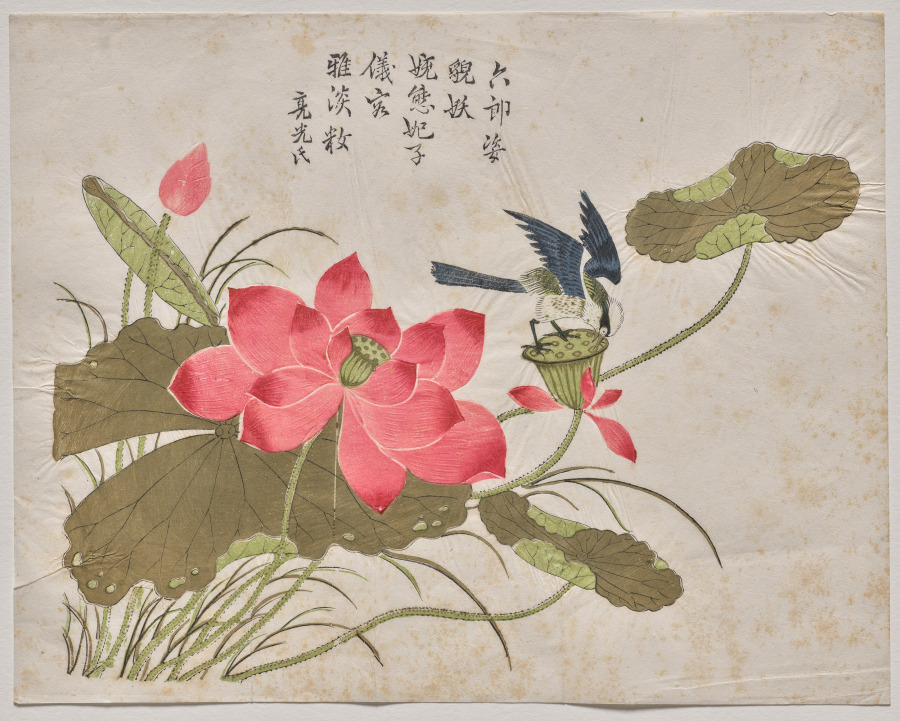
A blue-winged bird perches on a green lotus seed pod in Bird on Lotus, a print made in Suzhou between 1700 and 1750. The Cleveland Museum of Art lists two techniques in its catalog: multicolor woodblock printing and embossing. The color came from printing; embossing gave the paper relief. That distinction offers a way into Print Revolutions: Chinese Impressions, 1630s–1960s, which opened at the museum on Sunday, November 15.
In August 2025, Cleveland and the Metropolitan Museum of Art announced that they had divided a collection assembled by Christer von der Burg. Each museum received more than 100 prints. The curators sought to give both museums a range of styles and subjects while keeping sets together. Cleveland curator Clarissa von Spee put her museum’s share at 113 Suzhou prints.
The split makes for a useful comparison online. In the Met’s One Hundred Boys, children parade through a garden and play the board game go in a pavilion. As with the lotus print, the image was printed in multiple colors. But where Cleveland’s catalog records embossing, the Met’s records additional painting by hand. Put the records side by side and the shared label “woodblock print” turns out to describe only part of how each finished image was made.

The Cleveland show uses its Suzhou acquisition to tell part of a longer story. The museum’s current listing describes about 80 works, including paintings and porcelain as well as prints; that’s the scale of the exhibition, not the size of the acquisition. In her exhibition essay, von Spee also points to a separate acquisition of modern Chinese prints from the collections of Patricia and Thomas Ebrey, which helped the museum tell that history from its own holdings.
The show runs through April 4, 2027, in galleries 101A–B and 240A, and admission is free with no ticket required. The museum’s visitor page lists regular hours and holiday closures. The Cleveland catalog lists Bird on Lotus in gallery 101A. The Met labels One Hundred Boys “Not on view,” but its catalog lets readers see it online.