
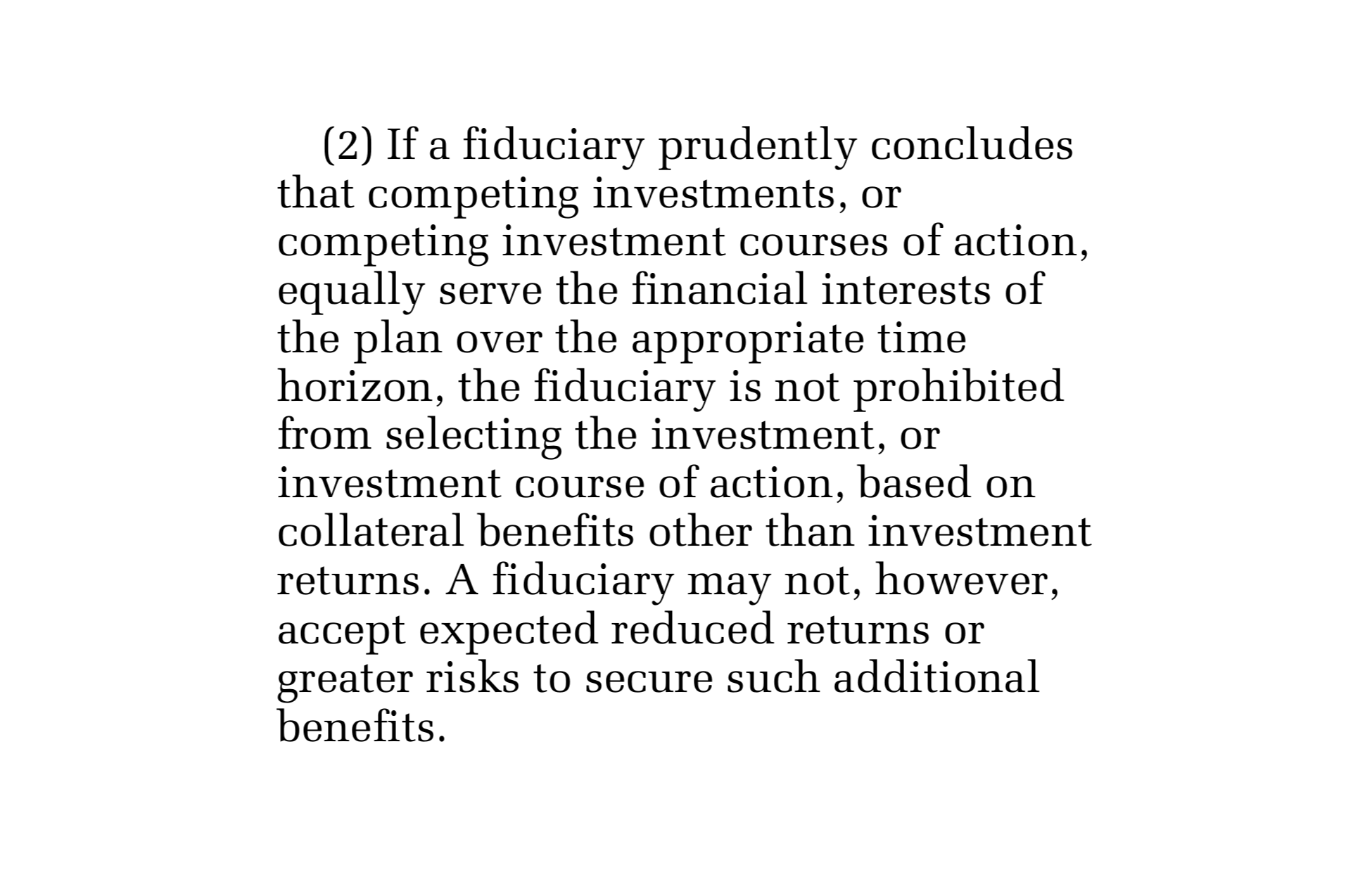
If the people who oversee a retirement plan prudently conclude that two investments equally serve the plan’s financial interests over the appropriate time horizon, a 2022 federal rule lets them use a benefit other than investment returns to break the tie. The Labor Department released a proposal on Nov. 23 that would remove that provision for plans covered by the Employee Retirement Income Security Act, or ERISA. It appeared in the Federal Register on Nov. 24.
The current rule already bars fiduciaries from accepting lower expected returns or greater risks to secure an unrelated benefit. It also says that, in a plan where participants direct their own accounts, taking their preferences into account does not by itself violate the duty of loyalty if the fiduciary follows the rule’s prudence requirements. The proposal would delete that explicit protection and direct fiduciaries to act exclusively to maximize participants’ and beneficiaries’ interests in retirement income or other financial benefits under the plan.
The distinction matters when a plan evaluates an investment exposed to climate risk, for example. The 2022 rule explicitly cites the economic effects of climate change as a factor that may affect risk and return. The proposed text drops the example but keeps the test of whether a factor is financially relevant to the particular investment. A risk that could affect the investment’s losses or returns could still enter the analysis. The proposal would remove the separate provision for choosing between financial equals based on an additional benefit.
The comparison also matters when a plan holds shares. The existing rule already requires fiduciaries to consider the cost of exercising shareholder rights and to act in the plan’s economic interest. The proposal would add back an explicit statement that fiduciaries need not vote every proxy or exercise every shareholder right. Prudence and loyalty would still govern the decision about whether to act.
The Federal Register notice sets Jan. 25, 2027, as the comment deadline and identifies the proposal as RIN 1210-AC37. The notice directs electronic comments to Regulations.gov. The proposal itself does not change the rule in force.