
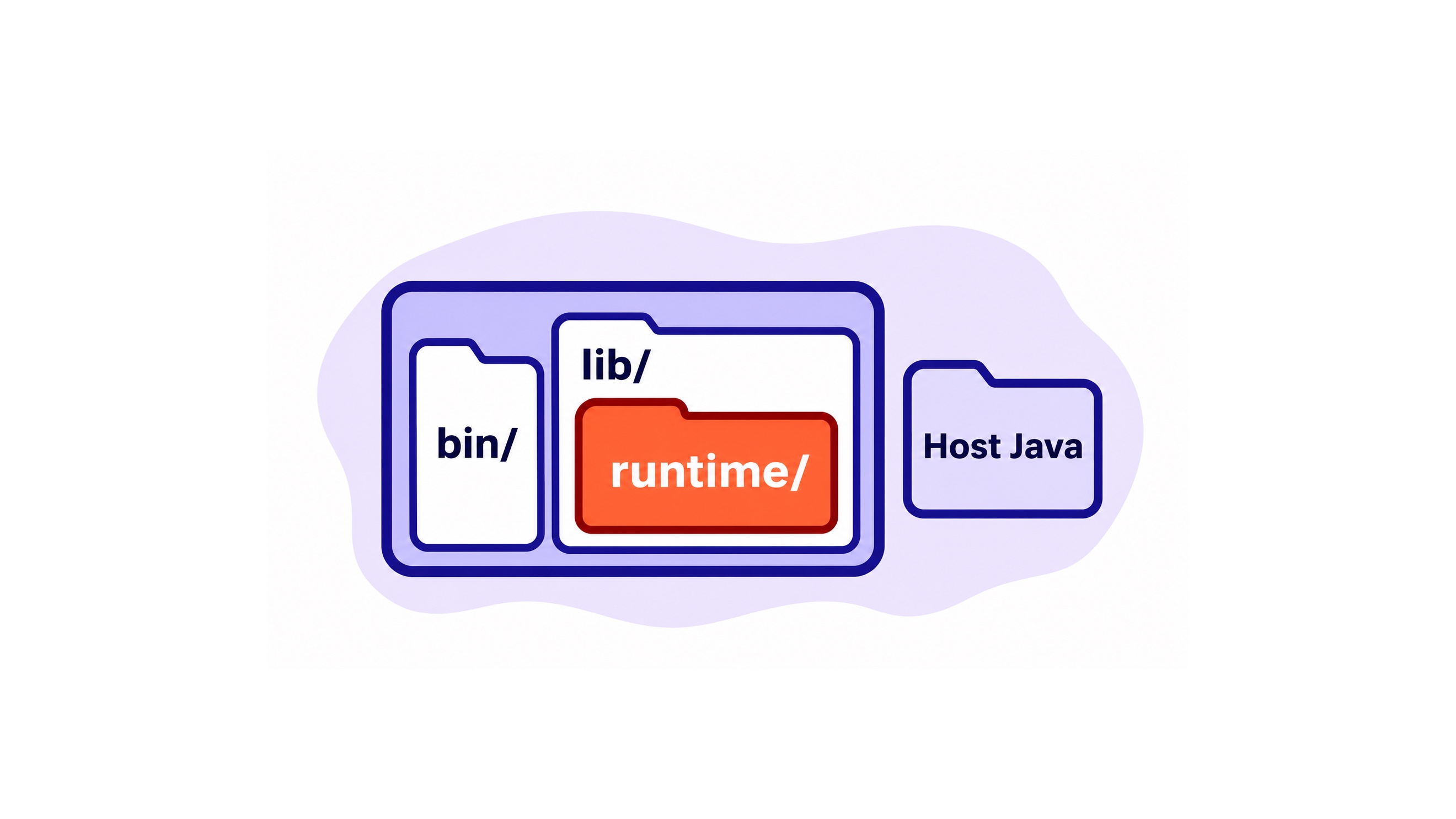
A team can update Java on a server and still have an application running its own older copy. That is the inventory gap behind the November 17 alert from the U.S. Cybersecurity and Infrastructure Security Agency on CVE-2026-114938, a flaw addressed in Oracle’s November security update. CISA wants teams to look inside third-party applications, container images and appliances, where Java may be absent from the inventory as a separate entry.
The distinction is visible in Oracle’s own packaging documentation. Its sample Linux application has a launcher and a Java runtime inside the same application directory. Updating a copy of Java elsewhere on the machine leaves that bundled copy in place. So the practical unit of work is the application: find the runtime it uses, identify the supplier and full build, then check that supplier’s guidance for the fix.
Oracle’s advisory lists affected versions of Oracle Java SE, Oracle GraalVM for JDK and Oracle GraalVM Enterprise Edition. For one example, the Java SE row lists 21.0.13.0.3 as affected, while the November release notes for Oracle JDK 21 identify 21.0.13.1+4 as the full build string of the update. Those numbers are a comparison for Oracle JDK 21. For Java shipped with an appliance or another vendor’s application, ask that supplier which supported release carries the fix.
CISA recommends patching as soon as the relevant updates are available and prioritizing internet-facing systems. After updating, check the build the deployed service actually uses. For a containerized service, make that check against the deployed image. The inventory entry you want to close is the one for the copy running the application.