
On a film budget, a camera operator’s pay and the cost of renting the camera go on different lines. That distinction matters for the federal film tax credit that industry advocates promoted Tuesday, Nov. 10, at the American Film Market in Los Angeles. The bill as introduced in the House bases the main credit on qualifying pay for work performed in the United States. Renting the camera would not itself generate that federal credit.
Screen reported from the market that Josh Rogin of the Motion Picture Association raised the possibility of the incentive taking effect by Jan. 1, 2027. That was an advocate’s timeline. The latest actions listed for the House and Senate bills are their Sept. 24 referrals to the House Ways and Means and Senate Finance committees, respectively. As written, the bills would apply to productions that begin principal photography in tax years starting after Dec. 31, 2026.
The House text sets a base rate of 20% of qualifying compensation, with increases that can take it to 30%. The main credit requires a project costing more than $1 million and, for a live-action production, requires a U.S. share of 75% of principal photography days. The bill also has separate rules for animation and certain postproduction and visual effects work.
California already has a different calculation. Under the California Film Commission’s Program 4.0 guidelines, eligible independent films can receive a base credit of 35% on up to $20 million in qualified expenditures. The state’s calculation can include qualifying nonpayroll expenses, such as a camera rented and used in California that meets the program’s rules. The commission’s allocation letter gives a project an estimate; a review after production determines the final amount, which can be lower.
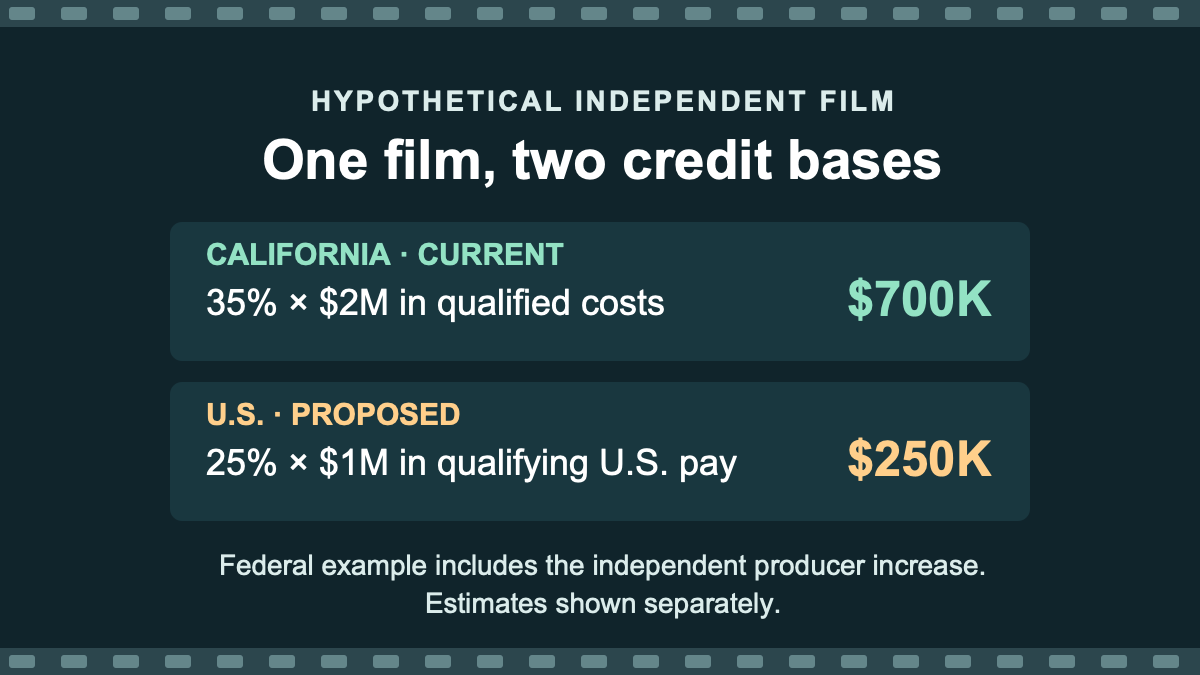
Take a hypothetical independent film with $2 million in expenses that all qualify under California’s rules, including $1 million in pay that also qualifies under the federal bill. Assume the producer also meets the federal bill’s definition of independent, which adds five percentage points to the federal base rate, and that no other increases apply. The California calculation is $700,000 at the state’s 35% base rate on qualified expenses; the federal calculation would be $250,000 at 25% on qualifying pay, assuming the project clears the other tests. Those are two illustrations of how the rules work, not an estimate of what the film could collect from both programs.
California’s program allocates $750 million in credits each fiscal year. Gov. Gavin Newsom proposed raising that to at least $1 billion on Nov. 2. Producers watching the two debates have separate questions to ask: whether they can secure an allocation under the California rules in force, and whether Congress will enact a federal credit in time for their shoot.